Taipei Layover Itineraries by the Hour
Short answer. Four hours buys two in the city, six buys four, and eight buys six and twenty. Every one of those numbers comes from the operators' own published itineraries, and the difference between them is not more stops — it is longer at each one, and a meal.
The three standard windows out of Taoyuan run four, six and eight hours, and every one of them prints its own timings. This guide puts all three side by side, stop by stop, so you can see exactly what an extra two hours buys before you pay for it.
Why every itinerary starts and ends with the same fifty minutes
Taoyuan is 40 km from the first stop on any of these routes, along Freeway 1. The operators do not estimate that drive: three separate itineraries print Taoyuan — 50 minutes as step one and again as the last step.
That is one hour forty out of every window regardless of length, which is why the shorter products feel so much shorter than their headline number. A four-hour tour and an eight-hour tour spend exactly the same time on the motorway.
Four hours: what two hours in the city looks like
- 50 minutes — Taoyuan to the city.
- 1 hour — Longshan Temple.
- 1 hour — Huaxi Street Night Market.
- 50 minutes — back to the terminal.
That is the published four-hour route, in full. Two stops, both free, both in Wanhua, and a twenty-minute walk between them. It is a coherent afternoon rather than a compromise: an old temple and the market street beside it is one of the best pairings in the city.
What it cannot absorb is traffic. One traveller's review of this route says plainly that traffic meant they never really reached the city. On a two-hour margin there is nothing to give, and rush hour on Freeway 1 runs roughly seven to nine in the morning and five to seven in the evening. More on that on short Taipei layovers.
Six hours: what four hours in the city looks like
- 50 minutes — Taoyuan to the city.
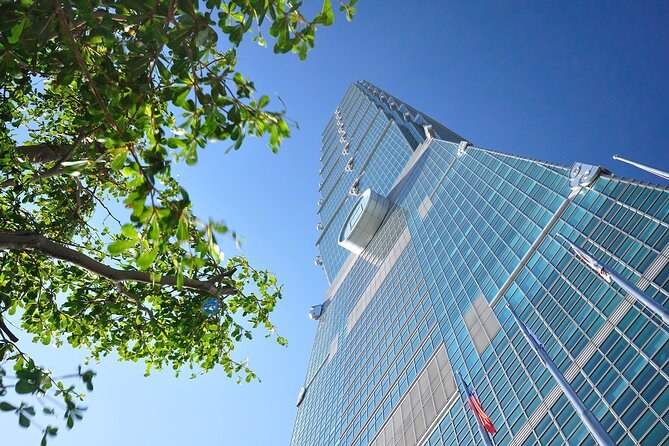
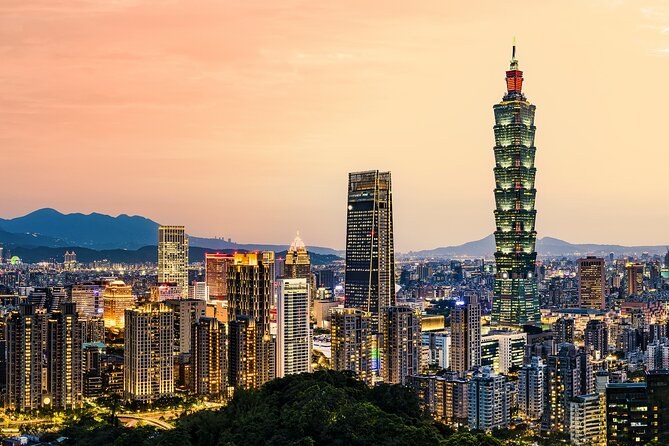
- 1 hour — Taipei 101, from the plaza or up the tower.
- 1 hour — Chiang Kai-shek Memorial Hall.
- 1 hour — Longshan Temple.
- 1 hour — Dihua Street.
- 50 minutes — back to the terminal.
This is the shape most people book and the one most people should. Four stops covers the skyline, the ceremonial heart of the city, its oldest working temple and its oldest trading street, and three of the four are free.
The second product at this length hands you the same six hours with the route left open: forty minutes on Dihua Street, forty at Longshan Temple, fifty at the memorial hall and an hour at Taipei 101, all of which you can overwrite. Which of the two suits you is a question about temperament, and it is answered on how to choose a Taipei layover tour.
Eight hours: what six hours and twenty minutes buys
- 50 minutes — Taoyuan to the city.
- 1 hour — Taipei 101.
- 1 hour — Chiang Kai-shek Memorial Hall.
- 1 hour — Ximen Red House, optional.
- 1 hour — Dihua Street.
- 1 hour — Longshan Temple.
- 1 hour — Huaxi Street Night Market.
- 50 minutes — back to the terminal.
Two extra stops and, more importantly, a night market at the end rather than a rush back. This is the first window where a proper meal is possible: xiaolongbao at a counter takes forty minutes, and on a six-hour run that is a stop you have given up.
What actually changes between four, six and eight hours?
| 4 hours | 6 hours | 8 hours | |
|---|---|---|---|
| Road, both ways | 1 h 40 | 1 h 40 | 1 h 40 |
| In the city | 2 hours | 4 hours | 6 h 20 |
| Stops | 2 | 4 | 6 |
| Free stops | 2 | 3 or 4 | 4 or 5 |
| A sit-down meal | No | Only instead of a stop | Yes |
| The observatory | No | Only instead of a stop | Yes |
| A night market | Yes, if timed late | Rarely | Yes |
| Room for traffic | None | One stop | Two stops |
The row that matters most is the last one. What you are buying with the extra hours is not sights, it is slack — and slack is what turns a connection you watched the clock through into a day you remember.
Which order should the stops go in?
Not the one printed, necessarily. The memorial hall is the only stop with a fixed clock: the honour guard changes hourly on the hour from nine until five and is called off in rain. Everything else is flexible, so the hall anchors the day.
Longshan Temple runs from six in the morning to ten at night and absorbs any leftover slot. Dihua Street's shops thin out after half past six. A night market only works in the evening. So a morning arrival runs hall, temple, street, tower; an evening one runs tower, temple, street, market and skips the ceremony.
What does an extra stop actually cost?
Twenty to twenty-five minutes of driving between central stops, on top of the time you spend at it. That is why six stops in eight hours works and eight stops in eight hours does not.
Outside the centre the numbers change sharply. The National Palace Museum is half an hour north, Beitou is thirty-five minutes, Jiufen is an hour. Each of those costs double its journey time because you have to come back. The full distance table is on the Taipei Layover tours map.
Can you fit Jiufen or Beitou into a layover?
Only on a twelve-hour connection, and only with a car. One charter product lists thirty-three selectable destinations including Jiufen, Yehliu, Shifen and Beitou's thermal valley, which makes it the one realistic way to do it.
The arithmetic is unforgiving. Jiufen costs two hours of road on top of the one hour forty you have already spent, so you need six hours in the city before it becomes a sensible stop rather than a drive. What each of them costs is on long Taipei layovers.
What does an overnight connection change?
Everything that has a clock. The memorial hall shut at six, the guard change finished at five, the observatory closes at nine, and the Airport MRT stops running around eleven. What is still trading is the night markets, and they trade late.
An overnight window is therefore a night-market window with a temple attached, and a private car is the only format that works, because it is the only one not tied to a timetable. Book the latest start the operator offers.
What does a five-hour tour look like?
One product here runs five hours rather than four or six, and it is shaped differently from everything else: the fare covers city metro, bus and taxi fares rather than a private car, and it will collect from Songshan, Taichung or Kaohsiung as well as Taoyuan.
Its published route is an hour each at Taipei 101, Chiang Kai-shek Memorial Hall and Longshan Temple, with two further hours placed wherever you ask. Because the transfers are on public transport rather than a private vehicle, the fifty-minute road figure does not apply in the same way — but the express train and the walk at each end take their own bite out of the same window.
Where does the time actually go?
Not where people expect. On a six-hour route the four stops account for four hours and the road accounts for one hour forty, which leaves twenty minutes of slack across the whole day. That is the honest picture, and it is why an unplanned queue at the observatory removes a stop rather than shortening one.
| Where the time goes | On a 6-hour tour | On an 8-hour tour |
|---|---|---|
| Road, both ways | 1 h 40 | 1 h 40 |
| At the stops | 4 hours | 6 hours |
| Slack | About 20 minutes | About 20 minutes |
| Driving between city stops | Inside the stop hours | Inside the stop hours |
The last row is the one that surprises people. Twenty to twenty-five minutes of city driving sits between each pair of stops, and it comes out of the hour allotted to the stop rather than being added on top. An hour at Longshan Temple is closer to forty minutes on the ground.
Which stops can you swap out?
Almost all of them. Three of these listings print no fixed route at all, and even the two with published hours treat one stop as optional. The most common substitutions travellers describe are a food stop for a monument, and a night market for the tower.
What cannot be swapped is the road, and what should not be swapped is the memorial hall if you land in the morning — it is the only stop with a fixed ceremony and it is free. The full list of what each stop gives you is on things to do in Taipei.
Building your own hour-by-hour plan
- Take the gap between your two flights.
- Subtract three hours at the departure end.
- Subtract forty-five minutes at the arrival end for immigration.
- Subtract one hour forty for the road.
- Divide what is left by an hour. That is your number of stops.
Then pick them in the order above, anchored on the guard change if you land in the morning and on a night market if you land in the evening. Every route compared on Taipei Layover tours and tickets is some version of that arithmetic.
One last piece of advice from the reviews rather than the listings: tell your guide what the plan is when you get in the car. Travellers who did describe days rebuilt around what they actually wanted, and travellers who did not describe following a route that was written for somebody else. The stop list is a starting position on almost every one of these products, and the person driving is the one who can change it.
Next: the case for and against booking at all is on the decision guide, and every departure is compared on Taipei Layover Tours.
The three lengths, compared