A Taipei Layover Without a Tour
Short answer. It works, and on a nine-hour connection with hand luggage it is the better answer. Complete the arrival card online, take the purple express from beneath your terminal, buy an EasyCard at Taipei Main Station, and leave the city three hours forty before your flight.
Nobody selling tours has an incentive to write this page, which is exactly why it should exist. Taipei is one of the easiest cities in Asia to do independently on a connection, and for a certain reader it is the right call. Here is the whole thing, in order.
Can you leave Taoyuan on your own?
Yes, if your nationality enters Taiwan visa-free — and a long list does, for 90 days. There is no special permit and no escort. You clear immigration as any arriving passenger does, walk out, and come back through departures later.
Check your own passport against the list Taiwan's Bureau of Consular Affairs publishes before you plan anything else. If you are staying airside none of this applies.
What do you have to do before you fly?
One thing: the Taiwan Arrival Card. Since 1 October 2025 it has replaced the paper form, it is completed online on the immigration agency's own portal, and it is free. The submission window opens seven days before you land.
Nothing has to be printed. The officer's passport scan pulls your record, which is what keeps the hall moving. Do it at the gate before your first flight and the only paperwork in your day is done. The agency has published its own warning that any site charging for it is not the government's.
Getting from the aircraft to the train
Allow thirty to forty-five minutes from the aerobridge to the arrivals hall, more if several long-haul aircraft land together. Then follow the signs down: the Airport MRT station sits directly beneath each terminal, A12 under Terminal 1 and A13 under Terminal 2.
Buy a single-journey token or an EasyCard at the machines. Take the purple express, not the blue commuter: 35 minutes to Taipei Main Station against 49. The express calls only at A1, A3, A8 and the two terminals.
What does the train cost?
| Ticket | What it covers | Price |
|---|---|---|
| Airport MRT round trip + 48-hour Taipei Metro pass | Both airport legs and two days on the city network | NT$520 |
| Airport MRT round trip + 72-hour pass | Both airport legs and three days | NT$600 |
| EasyCard | Metro, buses and convenience stores, pay as you go | Stored value |
Those two joint tickets are published by the operator and are the sensible buy for a day trip: they cover the airport legs and the city network in one purchase. An EasyCard on its own is the flexible option and works in convenience stores as well.
Where does the express actually put you?
Taipei Main Station, and nowhere else. That is the trade-off in one line: the train is fast to one point, and a car is slower to every point. From Taipei Main you are on the metro network, and the Bannan line alone links Longshan Temple, Ximending, the station and Taipei City Hall with no change.
Three of the four districts a layover uses are on that one line. The fourth, Xinyi and the tower, is a short hop away. The geography is on the Taipei Layover tours map.
A four-hour independent route that works
- Taipei Main Station. Buy an EasyCard, leave the platform level, take the Bannan line west.
- Longshan Temple. Its own station, free entry, thirty minutes.
- Ximending. One stop back east; twenty minutes of street life and the Red House.
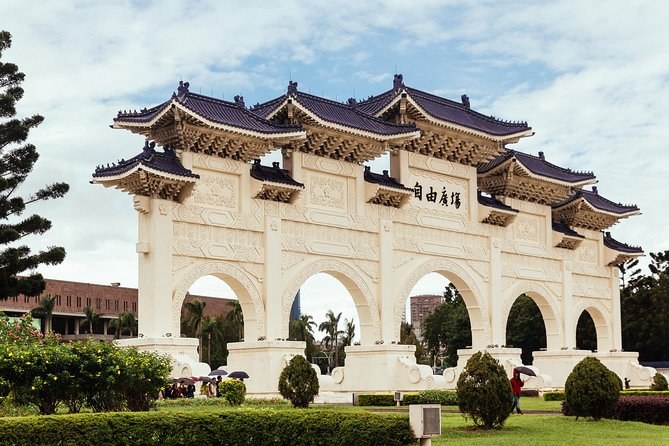
- Chiang Kai-shek Memorial Hall. Free, and the guard changes on the hour until five.
- Dihua Street. Twenty minutes north; shophouses and dried goods.
- Back to Taipei Main and the express.
That is four stops in about four hours, all of them free, all of them on the metro. It is very close to what the guided six-hour routes cover, which is worth being honest about.
What does the train not reach?
The National Palace Museum in Shilin, the National Revolutionary Martyrs' Shrine, Elephant Mountain and everything outside the city. Each is technically reachable and none is sensibly reachable inside a layover, because the connections cost you more time than the stop is worth.
If any of those is the reason you are going out, a car is not a luxury but the only option. The comparison is on Taipei private car tours.
What do you do with your luggage?
Both terminals at Taoyuan have baggage lockers and a staffed left-luggage counter, and using one is the difference between a good day and a long one. Anything you carry on the independent route, you carry all day, on trains and up temple steps.
If your checked bags are tagged through to your final destination you will not see them at all. If they are tagged only to Taipei, you collect them, clear customs and re-check them, and that is an hour nobody budgeted. Ask at your first check-in desk.
Getting back, which is the part that goes wrong
Leave the city three hours and forty minutes before your flight. Thirty-five minutes on the express, plus the walk to the platform at both ends, plus three hours at the airport is the arithmetic, and it has no slack in it.
The service window closes earlier than the airport does. The Airport MRT runs roughly six in the morning to eleven at night. An evening or overnight connection cannot rely on it, and that is the case where a car stops being optional — see long Taipei layovers.
What does an EasyCard do, and where do you get one?
It is a stored-value card that opens every metro gate and bus door in the city, and it works in convenience stores as well. Buy one at any station, load it, and stop thinking about tickets for the rest of the day.
The alternative on a single trip is a per-journey token from the machine at each station, which works fine but costs you thirty seconds and a decision every time. On a four-hour window that adds up. If you have bought one of the joint tickets above, the city network is already covered and the EasyCard is only useful for shops and buses.
What does it cost to eat while you are out?
Very little, and this is where the independent route quietly wins. A bowl of beef noodles, a plate of xiaolongbao or a run through a night market are all cheap by the standards of any airport, and none of them takes long.
Carry cash. Night market stalls, temple offerings and small food counters do not take cards, and three of these operators put the same advice in their own booking notes for exactly that reason. Department stores, chain restaurants and the observatory all take cards without a problem.
Is it safe to do alone?
Yes, and this is one of the easier cities in the world in which to be a stranger with a suitcase. Every metro station is signed and announced in English, exits are numbered, and the network runs on a frequency that removes most of the timing anxiety.
What is worth planning rather than improvising is the return leg, because that is where an independent day goes wrong. Know which train you are aiming for before you leave the last stop, and give yourself one service more than you think you need.
What if it rains?
Then the independent route gets harder in a way a car route does not, because the walking between metro exits and stops is where you get wet. The stops themselves are mostly fine: temples, arcaded shopfronts and covered markets all work in rain, and only the observatory view and the outdoor guard ceremony are genuinely lost.
Taipei rains a great deal — 235 mm in June, 237 in August — so this is not a remote possibility for half the year. The month-by-month picture is on the Taipei Layover weather page.
Who should do it this way, and who should not
Do it independently if your connection is nine hours or more, your bags are checked through or in a locker, you have done this kind of thing before, and your flight is at a civilised hour. You will save four fifths of the money and enjoy yourself.
Book a car if your window is seven hours or under, you are carrying anything substantial, you are travelling with children, your flight lands late, or the idea of watching the clock would spoil the day. That is not a sales line: it is the same list every experienced transit traveller would give you.
The middle of that range is where it is genuinely close. At eight hours with a daypack, both answers are defensible, and the deciding factor is usually how much sleep you had on the inbound. Nobody makes good decisions about metro maps after a red-eye, which is worth weighing honestly rather than optimistically.
The middle option
There is one product here built for exactly the reader this guide is written for: a host meets you at Terminal 2, rides the express in with you, and then walks the city at your pace. You get someone who knows what everything is, without spending your window in a vehicle.
What it does not give you is a boot or the stops beyond the metro, and the fares between stops inside the city are not covered by it. It is the most expensive product per person on this list and it owns no car at all, which tells you precisely what you are paying for.
Next: if you decide a car is the answer after all, the formats are on Taipei private car tours, and every departure is compared on Taipei Layover Tours.
If you would rather someone else watched the clock
Highlights & Hidden Gems With Locals: Best of Taipei Private Tour
PrivateFree cancellation
From $99 per person